Which Characteristic of Life Would Be Represented by a Baby Giraffe Getting Taller?
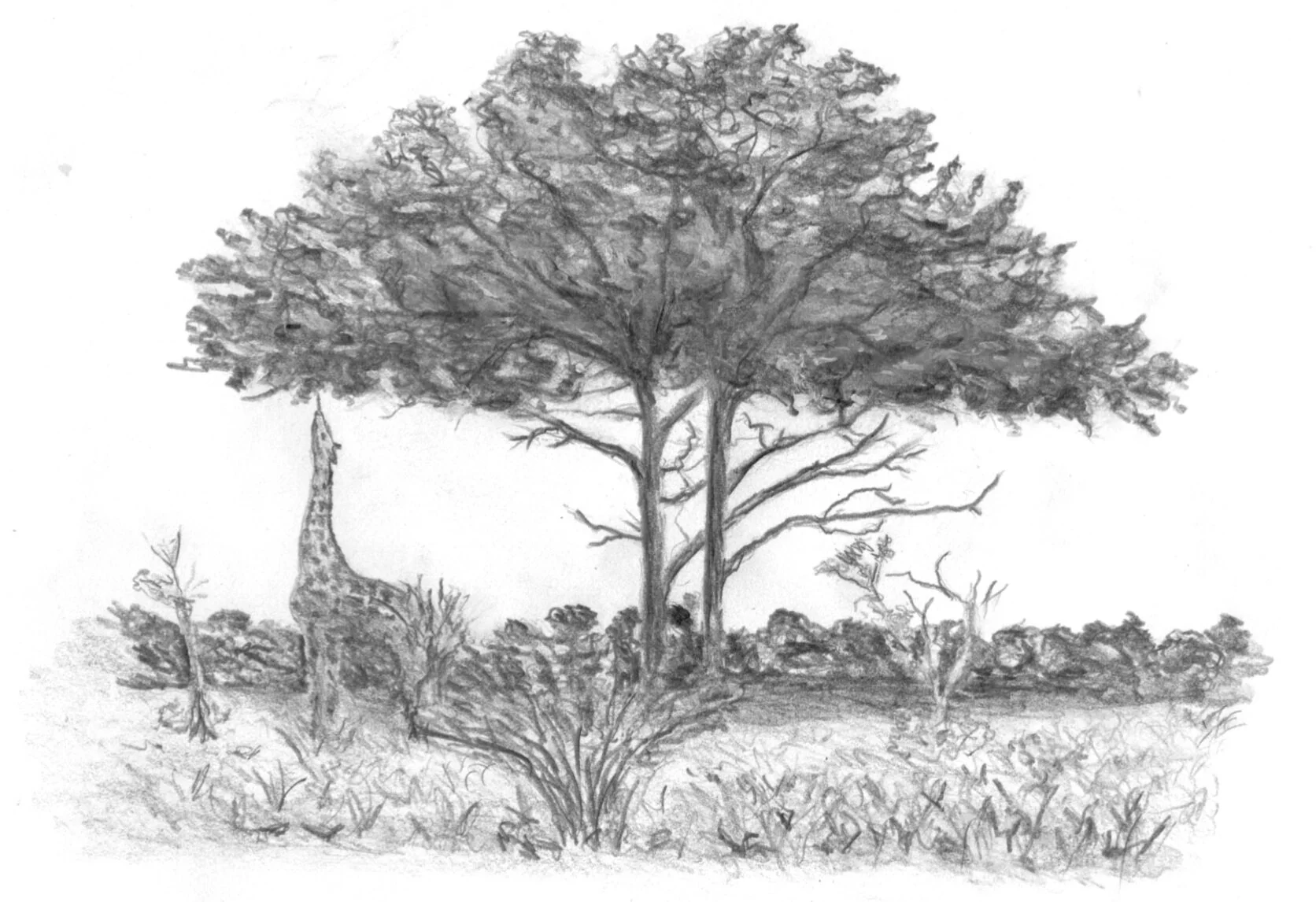
Figure 1. Giraffe in a "classic" feeding position, extending its neck, caput, and tongue to reach the leaves of an Acacia tree. (Tsavo National Park, Kenya; drawing by C. Holdrege)
View some of our other articles on whole-organism biology
Lamarck and Darwin
Once scientists began thinking about animals in terms of evolution, the giraffe became a welcome — and seemingly straightforward — example. Information technology is as if the giraffe's long neck was begging to be explained past evolutionary theorists.
One of the starting time evolutionary thinkers, Jean-Baptist Lamarck, offered a short description of how the giraffe evolved in his major piece of work, Philosophie Zoologique, which was published in 1809:
It is interesting to observe the consequence of habit in the peculiar shape and size of the giraffe: this animal, the tallest of the mammals, is known to alive in the interior of Africa in places where the soil is about always barren and barren, and then that it is obliged to browse on the leaves of trees and to brand abiding efforts to attain them. From this habit long maintained in all its race, it has resulted that the animate being's forelegs accept become longer than its hind-legs, and that its neck is lengthened to such a degree that the giraffe, without continuing upwards on its hind-legs, attains a peak of 6 meters. (Quoted in Gould 2002, p. 188)
In Lamarck'southward view, nosotros must imagine a situation in the past where the all-time food for browsing mammals was higher up in copse, the lower vegetation having been eaten by other animals. The ancestors of the giraffe — which we should imagine like antelopes or deer — needed to adjust their behavior to this changing environment. As Lamarck wrote, "variations in the environment induce changes in the needs, habits and modes of life of living beings ... these changes requite rise to modifications or developments in their organs and the shape of their parts" (p. 179). So Lamarck imagined that over generations the habit of continually reaching for the higher browse produced in the giraffe'due south ancestors a lengthening of the legs and neck.
A little over lx years later, Charles Darwin commented on giraffe evolution in the 6th edition (1872) of his seminal book, Origin of Species:
The giraffe, past its lofty stature, much elongated neck, forelegs, head and tongue, has its whole frame beautifully adjusted for browsing on the higher branches of copse. It can thus obtain food across the accomplish of the other Ungulata or hoofed animals inhabiting the aforementioned country; and this must be a great advantage to it during dearths.... So under nature with the nascent giraffe the individuals which were the highest browsers, and were able during famine to reach even an inch or two in a higher place the others, will often have been preserved; for they will have roamed over the whole country in search of food.... Those individuals which had some one part or several parts of their bodies rather more than elongated than usual, would generally have survived. These volition accept intercrossed and left offspring, either inheriting the same actual peculiarities, or with a tendency to vary over again in the aforementioned manner; whilst the individuals, less favoured in the same respects volition have been the about liable to perish.... Past this process long-continued, which exactly corresponds with what I have called unconscious pick past human being, combined no uncertainty in a most important manner with the inherited effects of the increased apply of parts, it seems to me most certain that an ordinary hoofed quadruped might exist converted into a giraffe. (Darwin 1872, pp. 177ff.)
In many respects this is a classic formulation of how Darwin viewed evolution: every species consists of individuals that show considerable variations. Under certain environmental conditions particular variations will be nearly advantageous. Natural option weeds out the unadapted and the best-adapted survive. These variations become dominant in the species and and then it evolves. In the case of giraffes, times of drought and arid conditions give an advantage to those animals that tin out-compete others past reaching the higher, untouched leaves. They form the bequeathed stock of the animals that evolve into giraffes.
Interestingly, Darwin believed in the "inherited effects of the increased use of parts" — a very "Larmarckian" view. Lamarck argued for the inheritance of acquired characteristics. Darwin felt that this was key to explain giraffe evolution; otherwise there is no guarantee that longer features in one generation will accept an effect on subsequent ones. Merely this view of the inheritance of caused characteristics is rejected by mainstream Darwinists today.
The Long Neck every bit a Feeding Strategy
The idea that the giraffe got its long neck due to food shortages in the lower reaches of copse seems well-nigh self-evident. The giraffe is taller than all other mammals, can feed where about no others can, and therefore has a singled-out advantage. It seems compelling to say that the long neck and legs developed in relation to this reward. Why else would the giraffe be and then tall? You notice this view presented in children'southward books, in web descriptions of the giraffe, and in textbooks.
Simply just because this explanation is widespread does non mean it is true. In fact, this "self-evident" explanation retains its power to convince only every bit long equally we do non become besides involved in the bodily biological and ecological details. Diverse scientists have noticed that this elegant picture of giraffe development dissolves under closer scrutiny. Here are a few examples of my and their objections:
1) Since the taller, longer-necked, evolving giraffe ancestors were too larger and heavier, they would need more than food than the animals they're competing with. Wouldn't this weigh their advantage in times of famine? Would they really have whatsoever advantage over smaller members of the same and other species? Moreover, it is absurd to presume that just the leaves on loftier branches were available to the giraffe during a drought. Had this been the case, then the multitude of browsing and grazing antelope species in Africa would all have gone extinct (or never evolved in the first place). So, even without growing taller, the giraffe ancestor could accept competed on even terms for those lower leaves.
2) Male giraffes today are up to one meter taller than female giraffes; newborn and immature giraffes are much smaller. The moment this sexual dimorphism manifested in the evolution of the giraffe, it would have been the males that could have reached the higher branches. The females and young animals would have died and the species would have gone extinct (Pincher 1949).
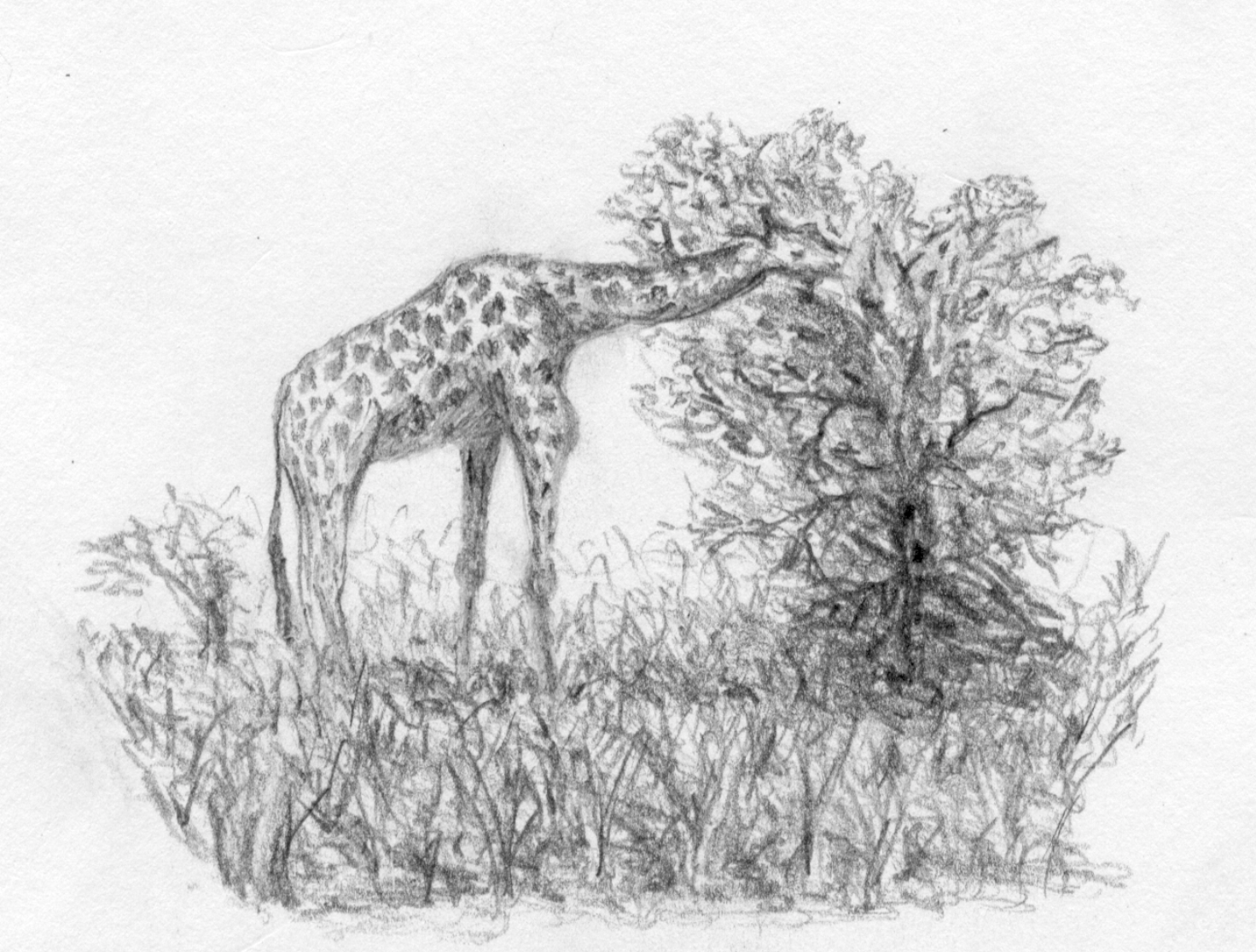
Figure ii. Giraffe feeding at about shoulder height — the most prevalent summit at which giraffes feed. (S of Moremi Game Reserve, Republic of botswana; drawing past C. Holdrege.)
iii) If giraffes evolved by eating high foliage during times of drought and maximal competition for nutrient, i would expect that giraffes today would also feed from the loftier foliage during these times in order to avert contest. Males unremarkably feed at greater heights than females and the results of one study prove a surprising spread (Ginnett and Demment 1997). Male giraffes fed nigh half of the time at heights of virtually five meters, that is, in the "classical" long-necked giraffe posture. In stark dissimilarity, females fed effectually 70 percent of the time at belly elevation or beneath, which the theory demands they should not exist doing. These researchers did not report on the seasons in which they made these observations, so their results are of fiddling help in discerning whether, for example, males feed at greater heights mainly during droughts.
A diversity of other studies evidence that giraffe feeding habits vary co-ordinate to place and time (reviewed in Simmons and Scheepers 1996). Giraffes move seasonally, and in the dry season in East Africa they tend to seek out lower valley bottoms and riverine woodlands. There they usually feed from bushes at or below shoulder height (about two and i half meters in females and three meters in males). Fifty percent of the fourth dimension they fed at a height of two meters or less, which overlaps with the feeding zone of larger herbivores such as the gerenuk and the kudu (Leuthold and Leuthold 1972; Pellew 1984). During the rainy flavour, when there is abundant browse at all levels, giraffes are more probable to feed from the higher branches, browsing fresh, protein-rich leaves. Other studies also show that giraffes do most of their feeding at about shoulder peak, with their necks positioned nearly horizontally (Young and Isbell 1991; Woolnough and du Toit 2001; see Effigy 2). So it looks as though giraffes are non using their long necks the way the theory demands. And they use them even less to reach heights in the dry out season, when the theory demands they should need them most!

Figure three. A goat does not require a long cervix to feed on twigs and leaves of an oak tree. (Cartoon past C. Holdrege after a photo in Butzer 2000.)
4) There are other means to achieve the loftier leafage of trees. Goats, for case, are known to climb into trees and eat leafage (run across Figure 3). Why didn't tree-climbing foliage-eaters (folivores) develop in the savannah? They would have had the advantage of feeding at all levels hands and been in that respect more than adjustable than the highly specialized giraffe. The long-necked gerenuk, an antelope, oft stands on its hind limbs and browses, reaching heights of two meters and more. The much larger and heavier elephant even stands sometimes on its back legs and extends its trunk to reach high limbs — but no one thinks that the elephant developed its trunk every bit a upshot of selection pressures to reach college nutrient.
In sum, there is nada in this theory that shows a compelling link between leg and neck lengthening and feeding on high limbs. Just considering giraffes have long necks and long legs and tin can achieve nutrient loftier in the trees does not mean that a need to achieve high browse was a causative gene in the evolution of those characteristics.
Clearly, both Darwin's and Lamarck's conceptions of giraffe evolution were highly speculative. The thought that giraffes developed longer legs and necks to reach higher nutrient seems plausible, fifty-fifty compelling, as long as we do not (ane) remember the idea through in all its implications and (ii) take into account essential observations of giraffe behavior and environmental. In the terminate, the thought is neither logically compelling nor based on fact.
Alternative Explanatory Attempts
Pincher (1949), after critiquing Darwin's explanation, suggests that the "about extraordinary feature of the giraffe is not the length of the neck simply the length of the forelegs." By developing long legs, the giraffe has caused a huge stride then that information technology can motility relatively fast for its size. This has left the giraffe with only i predator — the lion. Pincher therefore explains the "excessive length of its fore-legs as the effect of natural pick acting continually through the hunter-hunted relationship, every bit in the instance of hoofed mammals generally." The neck, in plough, followed the lengthening legs so that the giraffe could still reach the ground and drinkable.
Information technology is foreign that Pincher is able to critique Darwin's view so clearly and yet doesn't recognize that he is proposing the same type of inadequate explanation. The giraffe ancestor could just likewise have developed greater bulk or more than running muscles, both of which would have aided in avoiding predators. The fact is that despite its size and long stride, the giraffe is still preyed upon past lions. And equally i written report of one hundred giraffes killed past lions in South Africa showed, well-nigh twice every bit many bulls were killed as cows (Pienaar 1969; cited in Simmons and Scheepers 1996). The longer stride of bulls manifestly doesn't help them avoid lions better than the shorter legged females. Who knows whether their long step may in some style make them more vulnerable? Another speculative idea into the wastebasket.
Brownlee (1963) speculates that the lengthening of the limbs and neck in the giraffe give the giraffe a relatively large area, which should allow it to dissipate heat. This would be of advantage in the hot tropical climate, so that the trend toward lengthening would accept been encouraged by natural selection, since the largest animals would have been best able to survive estrus waves.
As in the other suggested "explanations," the cardinal question is, Is Brownlee's idea rooted in reality? Because of its long legs and neck, the giraffe appears to take a large surface surface area. But surface area alone is non of import; information technology is the relation of the heat producing book to expanse that is crucial. A minor animal has a small volume in relation to a very large surface area, while a large fauna has a very big book in relation to its relatively small-scale expanse.* At present the giraffe is a very large animal with a butt-shaped torso. Although its cervix is long, it is also voluminous; only the lower parts of the legs, which carry relatively few claret vessels, would act to enlarge the surface-to-volume ratio substantially. Krumbiegel (1971) estimates that the ratio of volume to surface in the giraffe is eleven:1, compared, say, to a smaller, long-necked antelope, the gerenuk, which has a ratio of 4.vii:ane (similar to the man). In other words, despite appearances, the giraffe even so has a very large volume in relation to its surface surface area and its unique grade provides no grounds to think that information technology evolved in relation to dissipating heat.
More recently, Simmons and Scheepers (1996) proposed that sexual selection has caused the lengthening and enlarging of the neck in males. These scientists place their ideas in relation to known facts and indicate out shortcomings in relation to larger contexts — a happy contrast to the other hypotheses we've discussed. They depict how male giraffes fight past clubbing opponents with their big, massive heads; the neck plays the office of a muscular handle. The largest (longest-necked) males are dominant among other male giraffes and mate more oft. Since long-necked males mate more than often, choice works in favor of long necks. This would also aid explicate why males have not only absolutely longer, just proportionately heavier heads than females. This hypothesis seems consistent with the deviation between male and female giraffes. At least it gives a movie of how the longer neck of males can be maintained in evolution. But it doesn't tell u.s.a. anything about the origin of neck lengthening in giraffes per se — the neck has to reach a length of one or two meters to be used as a weapon for clubbing. How did information technology go that long in the first identify? Moreover, the female person giraffe is left out of the explanation, and Simmons and Scheepers can only speculate that female person cervix lengthening somehow followed that of males. In the stop, the authors admit that neck lengthening could have had other causes and that head clubbing is a consequence of a long cervix and not a cause.
Does the Giraffe Actually Have a Long Neck?
All the higher up explanations of the evolution of the giraffe's long legs and long cervix are unsatisfying. Each of the authors sees problems in other explanations, but remains within the same explanatory framework when putting forward his ain hypothesis. No one sees the necessity for stepping outside the framework and looking at the difficulties of the overall approach. The scientists abstruse private features (long cervix, long legs, big surface surface area) and consider them in isolation from the rest of the organism. The individual characteristic is and so placed into relation to one purported causal cistron in the environment (drought, heat, predator abstention, male competition). The link of individual feature to environmental factor is supposed to explicate the evolution of that characteristic.
Only this is a highly problematic procedure. The giraffe'due south neck carries out a multifariousness of functions — it allows feeding from loftier branches, serves as a weapon in males, brings the caput to elevated heights that give the giraffe a large field of view, is used as a pendulum while galloping, and then on. Virtually all structures and organs in the brute body are multifunctional and interact dynamically with other multifunctional structures and organs. When scientists pick out a single function and focus solely on it to explain a multifunctional organ, their explanation can simply exist inadequate. This is comparable to believing you can paint a richly-nuanced, colorful rendition of a landscape with one color. It just does non work.
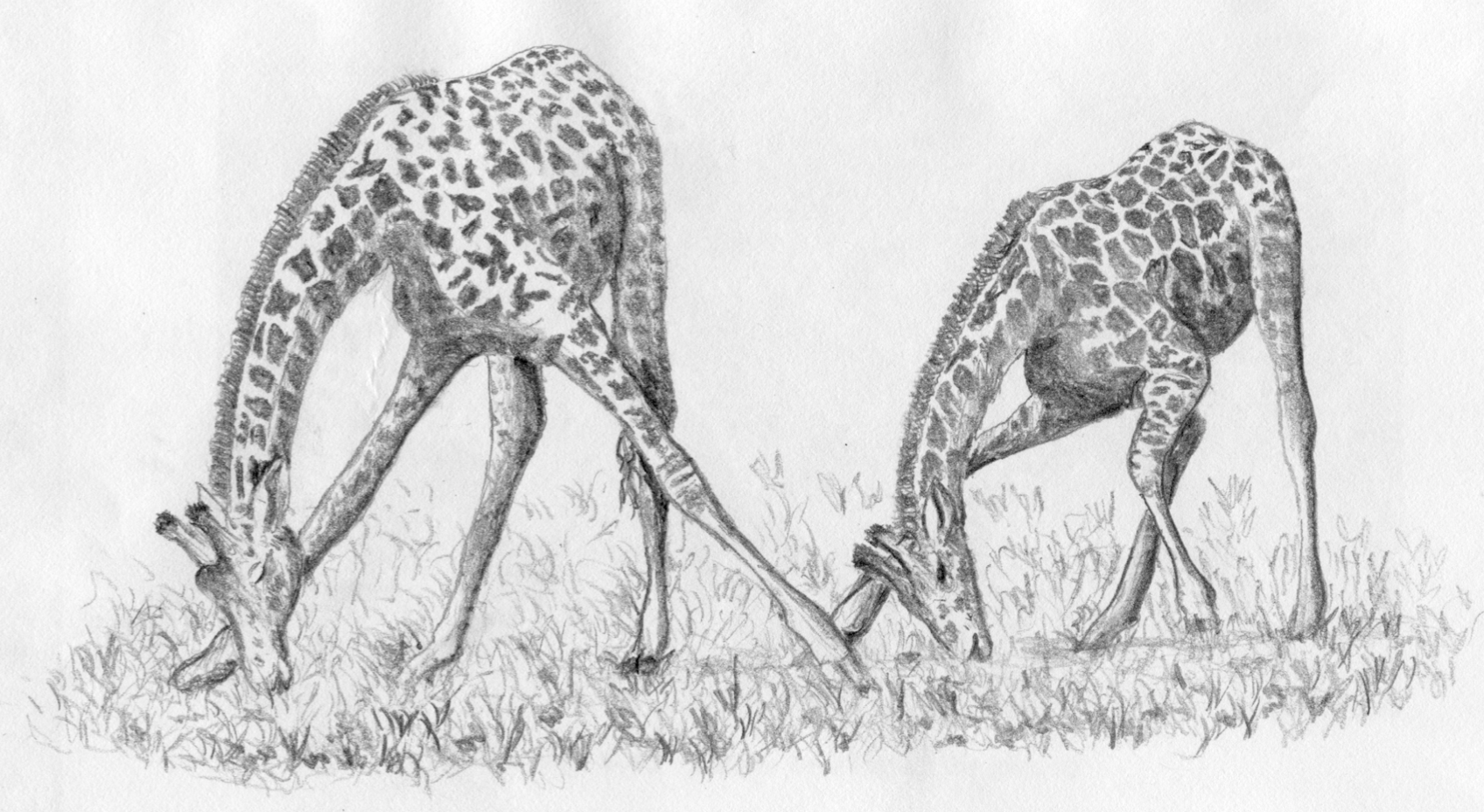
Effigy 4. "Short-necked" giraffes grazing. Giraffes tin only reach the ground with their mouths to drinkable or graze past splaying their front end legs (left) or splaying and bending their legs (right). (Drawing past C. Holdrege after a photo in Dagg and Foster 1982.)
I sometimes wonder why no ane has maintained that the giraffe has, in reality, a short neck. If y'all observe a giraffe drinking or, every bit they occasionally do, grazing close to the ground, then you know what I hateful (encounter Figure iv). Giraffes do non beverage often, merely when they do, they accept to either splay their forelegs to the side or bend their forelegs strongly at the wrist joint. Both procedures have time and are awkward for the giraffe. But only in this mode can it get the tip of its oral cavity downward to the surface of the water. So, looked at from the perspective of drinking, the giraffe has a very short cervix. Antelopes and zebras reach the ground without bending their legs, and the long-legged elephant has its body to compensate for its short cervix. Simply the giraffe (and its pelting forest relative, the Okapi) accept necks that are so brusk relative to their legs and chest that they must splay or bend their legs.
So why hasn't the giraffe become famous for its plain brusk cervix? Why don't we have evolutionary hypotheses explaining how the giraffe got its short neck? It is because the giraffe's neck, in other respects or from other perspectives, is long. No other mammal has such a long neck in absolute terms or in relation to the length of its torso. We all have seen (in life or in pictures) and been amazed by the continuing giraffe, its long neck sailing skyward, in comparison to which the ungainly, curt-necked drinking giraffe appears as exceptional, almost unfortunate behavior.
Whether the neck is long or curt depends on our perspective and on the behavioral or anatomical context we are focusing on. Nosotros but understand the giraffe when we view it from various perspectives and permit the giraffe bear witness dissimilar aspects of its being. The moment we focus solely on the "long neck" — and on it solely in terms of a food-gathering or some other strategy — nosotros've lost the reality of the giraffe.
Reality is richer than such explanations. The explanation may be coherent and logical, but what it explains is not the thing itself but a specter of information technology — the isolated aspect that has been bathetic from the whole organism. In reality, the organism as a whole evolves; all its parts are multifunctional, facilitating its interactions with its complex, changing environment. If we don't consider all partial aspects within this larger context, nosotros can only have inadequate explanations void of life.
In sum: the whole projection of explaining the evolution of an fauna by abstracting from the whole leads to unsatisfying, speculative ideas on the i hand, and to conceptual dissolution of the unity of the organism on the other. A more acceptable agreement requires that we first investigate the organism as a whole and how its members interrelate and collaborate within the context of the whole organism and its environment. This holistic understanding can then form the starting point for thinking about the evolution of the animal. The evolutionary biologist Dobzhansky'due south famous statement that "zippo in biology can be understood except in light of evolution" is a grand claim, which I believe is, in the end, truthful. But we take a lot of work to do before we get there, and nosotros should not be satisfied with short-cut evolutionary "explanations." Some other consequence of the usual mode of explaining is that the organism itself is atomized into private characteristics, each having its own caption. Each part takes on a quasi-reality of its own, while the whole organism — which brings along and gives coherence to the parts — degenerates into a kind of epiphenomenon, a mere blended of the surviving parts that "really" count.
If evolutionary thought is to have a solid foundation, we must establish this business firm grounding in holistic agreement. As information technology is, stories of the evolution of traits seem compel-ling until yous look for their context and foundation in the world and detect a puddle of quicksand. Equally Simmons and Scheepers remark about Darwin's idea of giraffe evolution, "it may exist no more than a tall story."
* Bold for the sake of caption a spherical body, the 2-dimensional surface grows as a function of the square of the radius, while the volume — being three-dimensional — grows as a function of the cube of the radius. A pocket-sized sphere with a radius of 2.5 cm (i inch) has a volume-to-surface ratio of 0.eight:1. A much larger sphere with a radius of 50 cm (about 20 inches) has a volume-to-surface ration of xvi.7:one.

For more of Craig's piece of work on the giraffe, meet the commodity "The Giraffe in Its Globe" and the monograph "The Giraffe'south Long Neck." Other articles on whole organism biology can be viewed here, or you can find Craig's latest volume on the topic, Seeing the Animal Whole—And Why It Matters, at our bookstore.
References
Brownlee, A. (1963). "Development of the Giraffe," Nature vol. 200, p. 1022.
Butzer, Karl (2000). "The Man Role in Environmental History," Nature vol. 287, pp. 2427-2428.
Dagg, Ann Innis, and J. Bristol Foster (1982). The Giraffe: Its Biology, Behavior and Environmental. Malabar FL: Krieger Publishing Company.
Darwin, Charles (1872). Origin of Species. Sixth Edition.
Ginnett, Tim, and Montague Demment (1997). "Sex Differences in Giraffe Foraging Behavior at Ii Spatial Scales," Oecologia vol. 110, pp. 291-300.
Gould, Stephan Jay (2002). The Construction of Evolutionary Theory. Cambridge, MA: Belknap Press.
Krumbiegel, Ingo (1971). Die Giraffe. Wittenberg (Germany): A. Ziemsen Verlag.
Leuthold, Barbara, and Walter Leuthold (1972). "Nutrient Habits of Giraffe in Tsavo National Park, Kenya," E. Afr. Wildl. J.vol. ten, pp. 129-141.
Pellew, Robin (1984). "The Feeding Environmental of a Selective Browser, the Giraffe (Giraffa camelopardalis tippelskirchi)," J. Zool., London vol. 202, pp. 57-81.
Pincher, Chapman (1949). "Evolution of the Giraffe," Nature vol. 164, pp. 29-thirty.
Simmons, Robert, and Lue Scheepers (1996). "Winning past a Neck: Sexual Pick in the Evolution of the Giraffe," The American Naturalist vol. 148, pp. 771-786.
Woolnough, A. P. , and J. T. duToit (2001). "Vertical Zonation of Browse Quality in Tree Canopies Exposed to a Size-Structured Society of African Browsing Ungulates," Oecologia vol. 129, pp. 585-590.
Immature, Truman, and Lynnsebell (1991). "Sexual activity Differences in Giraffe Feeding Ecology: Energetic and Social Constraints," Ethology vol. 87, pp. 79-89.
Source: https://www.natureinstitute.org/article/craig-holdrege/the-giraffes-short-neck
0 Response to "Which Characteristic of Life Would Be Represented by a Baby Giraffe Getting Taller?"
Postar um comentário